M
Maya Chen
Guest
- Thread Author
- #1
It’s 9 p.m., the forecast says 24°F, and your potted rosemary is still on the balcony. Here’s frost cloth vs fleece, plus the best frost protection for pots. I nearly lost that rosemary once, so let’s save yours.
I’m a former community-garden coordinator. These days I grow food and flowers on a sunny rooftop terrace in zone 7a [winter lows of 0 to 5°F]. My pots are mostly 5-gallon fabric bags and 12-inch terracotta planters. Everything below got tested up there, wind included.
Here’s what’s happening. A garden bed borrows warmth from deep, insulated earth. Your pot has only concrete underneath and wind on every side. That’s why a hardy shrub in the ground survives while its twin in a container doesn’t.
Good winter plant care starts with admitting that pots play by tougher rules. Roots freeze first, and frozen roots can’t drink, even when the leaves still look fine. A cover is cheap insurance against all of it.
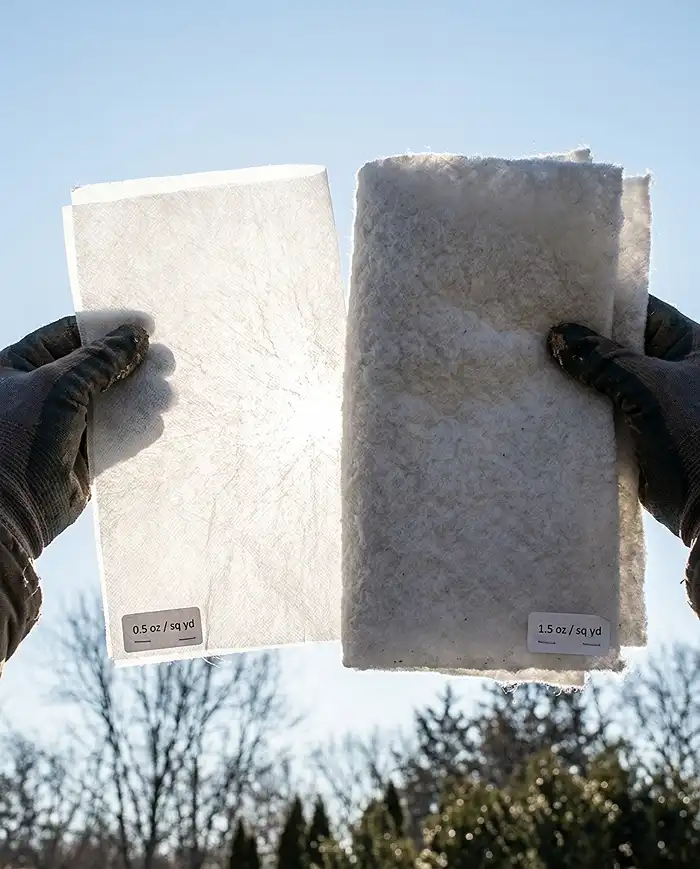
Both work the same way. They trap radiant heat [warmth the soil releases after sunset] beneath the fabric. That creates a microclimate [a small pocket of warmer air] around your plant. Neither one makes heat, so the cover only slows how fast it escapes.
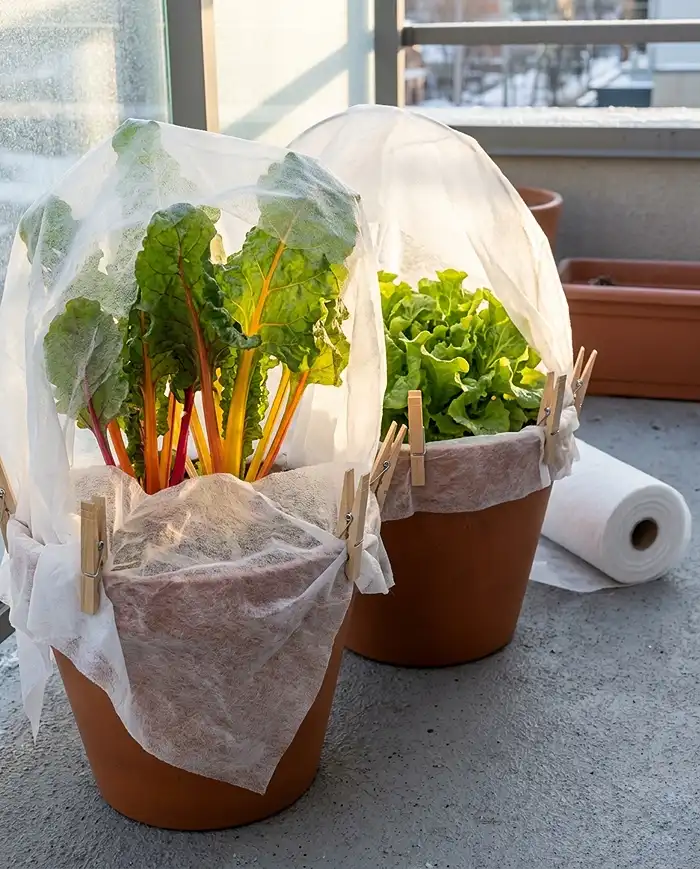
In November 2025, I covered ‘Bright Lights’ chard in 5-gallon pots with 0.55-ounce frost cloth. I kept picking until December 18, five weeks past our first frost, even after a 26°F night.
Think of it as a wool blanket versus a bedsheet. Both help, but only one gets you through a week of 15°F nights.
Wind matters more than most people expect. On my rooftop, a loose 0.5-ounce sheet shredded its hem in one gusty night. A 2-ounce fleece with the same anchors didn’t budge.
These figures are approximate. Wind, a tight seal and wet soil all shift the real result, so check your product’s label.
Try this: subtract the added protection from your forecast low, then compare it to your plant’s limit. A 24°F night plus 0.9-ounce cloth feels like about 30°F under the fabric. That’s fine for pansies and risky for citrus.
Plants that are still growing, like chard and lettuce, need that light. Dormant [resting, with growth paused] plants like lavender and fig shrug off dim conditions, which is why they tolerate heavy fleece better.
Look up your zone on the USDA Plant Hardiness Zone Map. Then check each pot’s hardiness [the lowest temperature a plant can survive] against your coldest expected night.
Hunting for balcony garden ideas that survive January? Cluster hardy pots together and wrap only the tender ones. Open, high balconies get far more wind, so lean toward heavier fabric and extra anchors there.
Tough plants make everything easier, so browse these cold-tolerant herbs for pots before you buy.
As of fall 2026, first frost in my zone 7a usually lands between late October and mid-November. I keep a roll by the door from Halloween on. For more cold-night tactics, read our guide on how to protect balcony plants from frost.
Check the plant’s hardiness first. Fleece buys you 8 to 10°F, not magic, so a tropical hibiscus still belongs indoors.
New to this? Our beginner small space gardening basics cover the tools and containers you’ll want. The steps below take about 20 minutes for a cluster of three pots.
Gardeners call it contact freezing [ice forming where wet leaves touch cold fabric]. Make stakes stand 8 to 12 inches above the canopy [the leafy top of the plant]. Cap each tip with an upside-down plastic cup so it can’t snag the cloth.
On my rooftop, I also clip the hem to the railing with clothespins. Check every knot at dusk, because wind loves a loose corner.
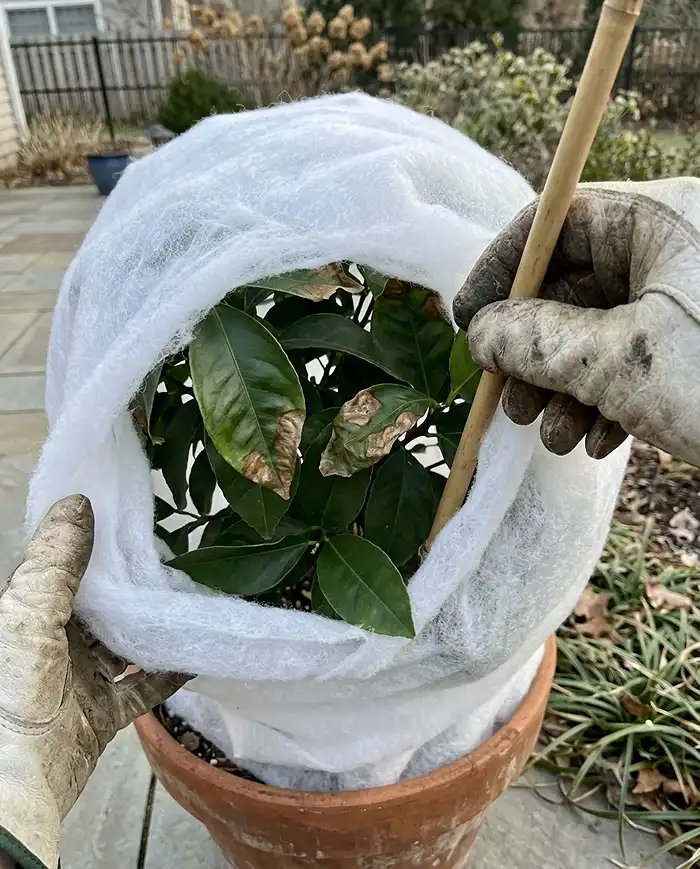
In January 2025, I draped fleece straight over my ‘Owari’ satsuma in a 20-inch pot. At 21°F, roughly a third of the leaves browned within two days. I rebuilt the teepee with a 2-inch gap, and the next freeze cost me nothing.
On a sunny day, the air under a sealed heavy cover can climb well past the outside temperature. Trapped moisture then sits on the leaves with nowhere to go, and mold loves that.
In December 2023, I left 2-ounce fleece on my ‘Tuscan Blue’ rosemary for nine days straight. A 52°F thaw hit on day six. By spring, gray mold had killed about half the branches in that 14-inch pot. Now I peel the cover back every sunny afternoon above 40°F.
These are the questions I hear most from neighbors on the rooftop and readers by email. Here are quick answers on shortcuts, daily routines and how long your fabric will last.
Skip the plastic. It traps moisture against the leaves, and that moisture freezes, which can do more harm than no cover at all. Cotton bed sheets work in an emergency, but they get heavy when wet and can crush stems. Use stakes to hold either one off your plants.
Not with lightweight frost cloth. It passes light and air, so it can stay on for days during a cold stretch. Heavy fleece is different: open it on sunny, above-freezing days so plants get light and the air can dry out.
Expect two to three seasons from either one with decent care. After winter, gently wash the fabric, let it dry completely, and fold it away. Store it out of direct summer sun, because UV light slowly breaks down the fibers.
Yes. Two layers trap an extra pocket of air and add a few degrees of protection. Keep the stake frame in place so neither layer touches the leaves.
Cover tender plants when forecast lows reach 32°F, and hardy cool-season crops closer to 28°F. Pots lose heat faster than ground beds, so don’t wait for the thermometer to prove it. Cover them in the late afternoon, before temperatures drop.
Both. Wrap the pot to protect the roots, since container roots freeze much faster than roots in the ground. Then cover the leafy top growth with frost cloth or fleece over a frame. Skipping either step leaves a weak spot.
I’m a former community-garden coordinator. These days I grow food and flowers on a sunny rooftop terrace in zone 7a [winter lows of 0 to 5°F]. My pots are mostly 5-gallon fabric bags and 12-inch terracotta planters. Everything below got tested up there, wind included.
Table of Contents
- The Battle Against the Cold: Why Balcony Pots Need Protection
- Frost Cloth vs Fleece: Understanding the Materials
- Key Differences and Performance Factors
- How to Choose the Right Cover for Your Balcony
- Step-by-Step Guide to Wrapping Balcony Pots
- Common Problems & Solutions
- Frequently Asked Questions
- Quick Recap
The Battle Against the Cold: Why Balcony Pots Need Protection
Short Answer: Balcony pots freeze faster than in-ground plants because cold reaches the roots from every side, with no deep soil to hold warmth. A fabric cover traps heat from the soil and slows that loss, which often decides whether plants survive a hard night.
Here’s what’s happening. A garden bed borrows warmth from deep, insulated earth. Your pot has only concrete underneath and wind on every side. That’s why a hardy shrub in the ground survives while its twin in a container doesn’t.
Good winter plant care starts with admitting that pots play by tougher rules. Roots freeze first, and frozen roots can’t drink, even when the leaves still look fine. A cover is cheap insurance against all of it.
Frost Cloth vs Fleece: Understanding the Materials
Short Answer: Both fabrics are spun synthetic sheets that slow heat loss. Frost cloth is thin, breathable and passes light, so it can stay on for days. Horticultural fleece is thicker and denser, so it holds more warmth but blocks more sun. Weight is the real dividing line.
Both work the same way. They trap radiant heat [warmth the soil releases after sunset] beneath the fabric. That creates a microclimate [a small pocket of warmer air] around your plant. Neither one makes heat, so the cover only slows how fast it escapes.
What is Frost Cloth (Spunbond Polypropylene)?
Short Answer: Frost cloth is a lightweight, UV-stabilized spunbond polypropylene [plastic fibers bonded without weaving] fabric. Most rolls run 0.5 to 1 ounce per square yard. It passes sunlight, air and water while adding a few degrees of warmth, so plants can stay covered for days.
In November 2025, I covered ‘Bright Lights’ chard in 5-gallon pots with 0.55-ounce frost cloth. I kept picking until December 18, five weeks past our first frost, even after a 26°F night.
What is Horticultural Fleece?
Short Answer: Horticultural fleece is a thicker, denser, softer fabric, often 1.5 to 3 ounces per square yard. It insulates far better than frost cloth, so it suits severe, prolonged cold snaps. The trade-off is less light, less airflow and slower drying, so you’ll need to watch it.
Think of it as a wool blanket versus a bedsheet. Both help, but only one gets you through a week of 15°F nights.
Key Differences and Performance Factors
Short Answer: Weight, not brand, drives nearly every difference. Frost cloth wins on light and breathability, while fleece wins on warmth. On a windy balcony both need anchoring, but heavier fleece flaps less. Match the weight to your coldest expected night, not the average forecast low.
Wind matters more than most people expect. On my rooftop, a loose 0.5-ounce sheet shredded its hem in one gusty night. A 2-ounce fleece with the same anchors didn’t budge.
Temperature Ratings and Frost Protection Levels
Short Answer: Thickness sets the protection level. Lightweight frost cloth around 0.5 ounce per square yard adds roughly 4°F, enough for a light frost near 28°F. Heavy fleece at 2 to 3 ounces adds around 8 to 10°F, which can carry plants through a hard freeze near 20°F.
| Fabric weight (oz per sq yd) | Type | Added protection | Light passing through | Best for |
|---|---|---|---|---|
| 0.5 to 0.55 | Light frost cloth | About 4°F | About 85% | Light frost near 28°F |
| 0.9 to 1.0 | Medium frost cloth | About 6°F | About 70% | Frost near 26°F |
| 1.5 | Light fleece | About 8°F | About 50% | Hard frost near 24°F |
| 2 to 3 | Heavy fleece | About 8 to 10°F | 30% or less | Hard freeze, 20°F and below |
These figures are approximate. Wind, a tight seal and wet soil all shift the real result, so check your product’s label.
Try this: subtract the added protection from your forecast low, then compare it to your plant’s limit. A 24°F night plus 0.9-ounce cloth feels like about 30°F under the fabric. That’s fine for pansies and risky for citrus.
Breathability, Moisture, and Light Transmission
Short Answer: Frost cloth lets light and moisture pass, so condensation rarely builds up. Heavier fleece blocks more sunlight and holds humidity underneath. Left on too long, especially through gray weeks, it can invite mold and pale, weak growth, so check it often.
Plants that are still growing, like chard and lettuce, need that light. Dormant [resting, with growth paused] plants like lavender and fig shrug off dim conditions, which is why they tolerate heavy fleece better.
How to Choose the Right Cover for Your Balcony
Short Answer: Choose by three things: your lowest expected night temperature, how hard wind hits your balcony, and whether the plant is still growing. Growing crops want light frost cloth. Dormant or tender plants in sub-freezing stretches want heavy fleece. When unsure, start light and add layers.
Look up your zone on the USDA Plant Hardiness Zone Map. Then check each pot’s hardiness [the lowest temperature a plant can survive] against your coldest expected night.
Hunting for balcony garden ideas that survive January? Cluster hardy pots together and wrap only the tender ones. Open, high balconies get far more wind, so lean toward heavier fabric and extra anchors there.
Tough plants make everything easier, so browse these cold-tolerant herbs for pots before you buy.
Best Uses for Lightweight Frost Cloth
Short Answer: Use lightweight frost cloth to extend your autumn vegetable harvest, shield cool-season annuals like pansies, and guard against sudden, mild overnight frosts. It works best when you still need daytime sun to reach the plants and nights stay above about 25°F.
- Lettuce, spinach and chard in 12-inch pots
- Pansies and violas through November
- Any pot facing a surprise one-night dip to 30°F
As of fall 2026, first frost in my zone 7a usually lands between late October and mid-November. I keep a roll by the door from Halloween on. For more cold-night tactics, read our guide on how to protect balcony plants from frost.
Best Uses for Heavy-Duty Horticultural Fleece
Short Answer: Reach for heavy fleece to overwinter tender perennials, citrus trees and Mediterranean herbs through long, sub-freezing stretches. These plants are dormant or slow, so they don’t need much light. Pair the fleece with a wrapped pot for the best results.
- Citrus such as ‘Owari’ satsuma mandarin
- Rosemary, lavender and bay laurel
- Tender perennials like lantana
Check the plant’s hardiness first. Fleece buys you 8 to 10°F, not magic, so a tropical hibiscus still belongs indoors.
Step-by-Step Guide to Wrapping Balcony Pots
Short Answer: Wrap in three moves. Water and insulate the pot first, build a frame so fabric never touches leaves, then anchor the base tight. Do it in the afternoon, before the storm, while the soil still holds the day’s warmth. Good winter plant care is mostly good timing.
New to this? Our beginner small space gardening basics cover the tools and containers you’ll want. The steps below take about 20 minutes for a cluster of three pots.
Step 1: Pre-Watering and Insulating the Container Base
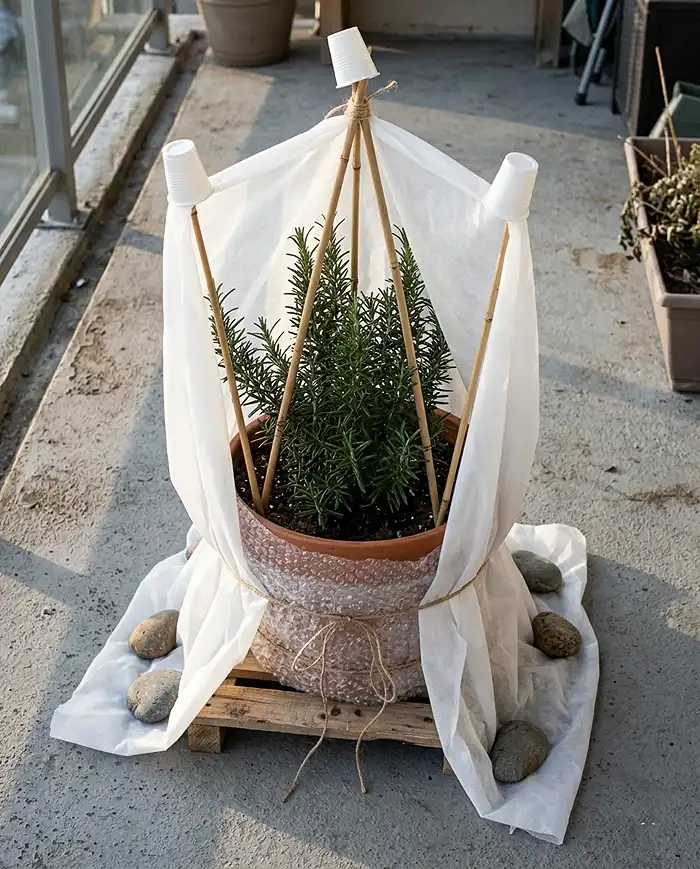
Short Answer: Water the soil deeply in the morning, because moist soil holds and releases more heat than dry soil. Then wrap the pot in bubble wrap or burlap. Set it on a wooden pallet or foam board so cold concrete can’t pull warmth from the base.
- Water the morning before the freeze, never into frozen soil
- Wrap the pot sides with two layers of bubble wrap or burlap
- Lift the pot onto a pallet, foam board or two bricks
- Group pots together against the wall
Step 2: Creating a Support Frame for the Canopy
Short Answer: Push three or four bamboo stakes into the soil and tie them at the top into a teepee. The frame holds fabric away from the leaves. That gap matters because wet leaves pressed against cold fabric freeze on contact, and the damage follows.
Gardeners call it contact freezing [ice forming where wet leaves touch cold fabric]. Make stakes stand 8 to 12 inches above the canopy [the leafy top of the plant]. Cap each tip with an upside-down plastic cup so it can’t snag the cloth.
Step 3: Securing the Cover Against Balcony Winds
Short Answer: Drape the cover over the frame, then gather it tightly around the pot and cinch it with twine or a bungee cord. Weigh down any loose hem with stones or bricks. A sealed base traps rising radiant heat, and a tight cover won’t flap loose overnight.
On my rooftop, I also clip the hem to the railing with clothespins. Check every knot at dusk, because wind loves a loose corner.
Common Problems & Solutions
Short Answer: Two problems cause most winter fabric failures: leaves freezing onto the cover, and plants cooking under heavy fleece during a thaw. Both are easy to prevent with a proper air gap and a daily glance at the forecast, even on busy mornings.
Foliage Freezing directly to the Cover
Short Answer: When leaves touch the fabric, condensation freezes them to it and burns the tissue. Fix it by adjusting the stake frame so at least one inch of air separates every leaf from the cover. Press gently on the outside, and if you feel leaves, raise the stakes.
In January 2025, I draped fleece straight over my ‘Owari’ satsuma in a 20-inch pot. At 21°F, roughly a third of the leaves browned within two days. I rebuilt the teepee with a 2-inch gap, and the next freeze cost me nothing.
Overheating and Mold During Winter Thaws
Short Answer: Heavy fleece traps heat and humidity, so a sunny thaw can cook or rot the plant underneath. Check the forecast daily, and vent or remove the cover whenever daytime temperatures climb above 40°F (4°C). Re-cover before dusk, once the air starts cooling again.
On a sunny day, the air under a sealed heavy cover can climb well past the outside temperature. Trapped moisture then sits on the leaves with nowhere to go, and mold loves that.
In December 2023, I left 2-ounce fleece on my ‘Tuscan Blue’ rosemary for nine days straight. A 52°F thaw hit on day six. By spring, gray mold had killed about half the branches in that 14-inch pot. Now I peel the cover back every sunny afternoon above 40°F.
Frequently Asked Questions
These are the questions I hear most from neighbors on the rooftop and readers by email. Here are quick answers on shortcuts, daily routines and how long your fabric will last.
Can I use plastic garbage bags or bed sheets instead of frost cloth?
Skip the plastic. It traps moisture against the leaves, and that moisture freezes, which can do more harm than no cover at all. Cotton bed sheets work in an emergency, but they get heavy when wet and can crush stems. Use stakes to hold either one off your plants.
Do I need to take the frost cloth off every single morning?
Not with lightweight frost cloth. It passes light and air, so it can stay on for days during a cold stretch. Heavy fleece is different: open it on sunny, above-freezing days so plants get light and the air can dry out.
How long do frost cloth and horticultural fleece last?
Expect two to three seasons from either one with decent care. After winter, gently wash the fabric, let it dry completely, and fold it away. Store it out of direct summer sun, because UV light slowly breaks down the fibers.
Can I layer frost cloth and fleece together?
Yes. Two layers trap an extra pocket of air and add a few degrees of protection. Keep the stake frame in place so neither layer touches the leaves.
At what temperature should I cover my potted plants?
Cover tender plants when forecast lows reach 32°F, and hardy cool-season crops closer to 28°F. Pots lose heat faster than ground beds, so don’t wait for the thermometer to prove it. Cover them in the late afternoon, before temperatures drop.
Should I cover the pot, the plant, or both?
Both. Wrap the pot to protect the roots, since container roots freeze much faster than roots in the ground. Then cover the leafy top growth with frost cloth or fleece over a frame. Skipping either step leaves a weak spot.
Quick Recap
- Pick by weight: frost cloth vs fleece comes down to your coldest night and whether plants still need light.
- Use light frost cloth for frosts near 28°F and heavy fleece for 20°F and below.
- Water deeply, wrap the pot, and raise a stake frame with a 1-inch air gap.
- Anchor the base tight so balcony wind can’t steal the heat.
- Vent or remove heavy fleece when daytime temperatures pass 40°F (4°C).