The Blunders of a Bashful Man — Reading Notes
Edition facts
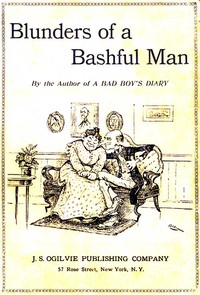
The narrator of The Blunders of a Bashful Man opens by declaring himself the only bashful man in the world, a claim he offers with a mixture of pride and self-pity. He compares his affliction to diseases that can be survived or poisons that lose their effect, but insists bashfulness is incurable. This hyperbolic medical metaphor sets the tone for a comedy built on the gap between the narrator's internal panic and the absurd situations he stumbles into.
The excerpts show a pattern: each chapter title announces a social occasion—a picnic, an evening call, a tea-party—that becomes a fresh disaster. The narrator's voice is formal, self-deprecating, and oddly patient, as if he is recounting a long series of natural disasters rather than his own choices.
A Malady Without Remission
The narrator frames his bashfulness as a permanent condition, distinct from ordinary shyness. He claims he can take 444 grains of arsenic safely but cannot become hardened to the “thousand petty stings” of embarrassment. This mock-medical language recurs throughout the excerpts, treating social anxiety as a physical ailment with no cure. The narrator’s tone is rueful but not desperate; he describes his history as a “long series of embarrassments and mortifications” with a mild wonder that he has not committed suicide. Yet he immediately undercuts that thought by noting that even suicide would be too embarrassing—he cannot bear the idea of being found with a black-and-blue face or a swollen one. The humor depends on this layering: the narrator is too bashful to kill himself because he would be embarrassed by the corpse.
The Pursuit of a Reluctant Groom
In the most extended excerpt, the narrator is cornered by Sally Spitfire, a young woman who announces she has “frozen to” him and demands he marry her immediately. She carries a Colt revolver and threatens to shoot him if he refuses. The narrator’s response is not fear but a desperate calculation: he leaps from a moving train to escape. The scene is structured as a chase, with the narrator’s escape attempts foiled at every turn. When he jumps, Sally jumps after him, bleeding from the nose but still smiling. The comedy lies in the inversion of gender expectations—Sally is the aggressor, the narrator the prey—and in the narrator’s complete inability to assert himself. He does not argue or fight; he simply tries to flee, and even that fails. The episode ends with Sally holding him at gunpoint on the prairie, insisting they find a minister.
Voice and Structure: The Bashful Man’s Testimony
The narrator’s voice is consistent across the excerpts: formal, slightly archaic, and given to self-conscious asides. He addresses the reader directly, using phrases like “as true as I'm writing this” and “I thought for full two minutes.” The chapters are short and titled with simple declarative statements (“HE ATTENDS A PICNIC,” “HE COMMITS SUICIDE”), which promise action but deliver anticlimax. The narrator’s passivity is the engine of the plot; he does not act so much as react, and his reactions are always too late or too awkward. The excerpts suggest a structure of escalating mishaps, each chapter a new social setting that the narrator enters with dread and leaves in chaos. The humor is cumulative, relying on the reader’s familiarity with the narrator’s pattern of blundering.
The excerpts offer a clear sense of the narrator’s voice and the comic mechanism of the book, but they do not reveal the full arc of his adventures. Readers should expect a series of self-contained episodes rather than a continuous plot, and the humor depends on the narrator’s deadpan delivery of his own humiliations. The book rewards attention to the gap between what the narrator says and what he does, and to the way his bashfulness shapes every interaction.