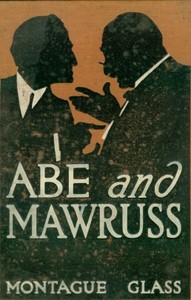
Abe and Mawruss: Being Further Adventures of Potash and Perlmutter — Reading Notes
Edition facts
The novel opens with a heated exchange between partners Abe Potash and Morris Perlmutter over the meaning of "philantropist," a mispronunciation that immediately signals the book's linguistic play. Abe insists Max Linkheimer is "one fine man," while Morris retorts that Linkheimer "would talk a tin ear on to you." This argument, set in a sweltering July showroom, establishes the partners' contrasting temperaments and the central role of miscommunication and banter in their relationship. The dialogue is dense with Yiddish-influenced syntax and idioms, such as "I bet yer" and "such another one of them fellers," which give the text a distinctive oral quality. The opening also introduces the garment trade as the backdrop, with references to the subway, lodges, and business rivalries, grounding the comedy in a specific social and professional milieu.
Dialogue as Character Revelation
The excerpts rely almost entirely on dialogue to convey character and conflict. In the opening, Abe and Morris's disagreement over Max Linkheimer reveals not only their differing views on sociability but also their speech patterns: Abe is more emphatic and literal, while Morris is sardonic and prone to exaggeration. Their exchange is punctuated by gestures—Morris shrugs, Abe rises to his feet—that underscore the performative nature of their arguments. Later, in the cutting room, Abe's bellowed "Koosh!" and his complaint about running "a cloak-and-suit house oder a theayter" show his impatience with anything that distracts from business. The dialogue never becomes expository; instead, it advances the plot through misunderstandings and pointed remarks, such as Morris's claim that "everybody is stealing our business." This technique makes the reader an eavesdropper on a world where words are weapons and status is negotiated through verbal sparring.
The Garment Trade as a World of Its Own
The setting is not merely background but a source of conflict and humor. The partners' business concerns—buttons, cloaks, suits—are woven into every conversation. Morris's retort about Max Linkheimer's philanthropy being tied to the button business links character judgment to commercial self-interest. The cutting room, where Aaron Shellak is caught practicing violin, becomes a stage for the clash between art and commerce. Abe's fury at the violin during business hours reflects the relentless pressure of the trade, while Aaron's secret aspiration to be a virtuoso introduces a subplot about talent and economic necessity. The excerpts also mention specific New York locations—the Harlem Winter Garden, Second Avenue restaurants—that root the story in the Jewish immigrant experience of the early 1900s. The garment trade is depicted as a demanding, gossipy, and competitive environment where personal and professional lives are inseparable.
Comic Misunderstandings and Linguistic Play
Glass's humor derives from malapropisms, mispronunciations, and cultural collisions. The word "philantropist" is a running joke, with Morris misinterpreting it as a synonym for "schmooser" (a talker). This linguistic confusion is not just comic but thematic: it highlights the characters' struggle with English as a second language and their tendency to judge others through a flawed vocabulary. Later, the violin subplot introduces a different kind of misunderstanding: Aaron Shellak's brother Louis, a restaurant orchestra leader, insists that Aaron could make money as a fiddler if only he had the right hair. The absurdity of valuing hair over skill is played straight, and Aaron's practical question—"Whose money?"—underscores the economic realities that govern all decisions. The narrative voice occasionally shifts to a more formal register, as in the description of Aaron's "lean, scholarly face," which contrasts sharply with the dialogue's colloquialism, creating a dry, ironic distance.
Structural Hints from the Excerpts
The excerpts suggest a episodic structure, with each chapter likely focusing on a different scheme or conflict. The table of contents lists titles like "The Judgement of Paris" and "Dead Men's Shoes," which promise ironic twists on familiar phrases. The opening chapter, "Sympathy," begins with a trivial argument that escalates into a broader commentary on business ethics and personal loyalty. The middle excerpt, involving Aaron Shellak's violin, introduces a new character and a subplot that seems to run parallel to the main narrative. The later excerpt, where Morris complains about competitors stealing business, returns to the theme of rivalry and suggests that the partners' adventures are driven by external threats as much as internal squabbling. Without reading the full text, it is reasonable to infer that the novel balances serialized misadventures with ongoing character development, using the garment trade as a flexible framework for comedy.
Readers approaching Abe and Mawruss should attend to the rhythm of the dialogue and the specificity of the setting. The humor is cumulative, building on repeated patterns of miscommunication and the characters' unwavering self-interest. The excerpts offer a reliable guide to the tone: expect sharp exchanges, Yiddish-inflected English, and a world where every conversation circles back to business. The novel rewards patience with its linguistic texture and its unsentimental portrait of immigrant entrepreneurship.