M
Maya Chen
Guest
- Thread Author
- #1
Fertilizing indoor herbs in winter works at quarter strength, once every 6 to 8 weeks. Anything heavier scorched my herbs in pots within five weeks of feeding.
I run trials on a south-facing concrete patio in zone 8b. This test used 12 pots from November 15, 2025 to March 15, 2026. Six overwintered in an unheated mudroom (45-55°F). Six sat in the kitchen at 68°F under LED lights.
These notes are current as of the 2026 season. No new product I tried changed the schedule.
Verdict: Skip your summer schedule. Winter herbs grow slowly, so unused fertilizer builds up as salt and burns the roots.
Low light and cool rooms slow a plant’s metabolism [how fast it turns food and water into growth]. Roots drink less, so they take up less fertilizer. The rest sits in the pot as salts [leftover mineral residue].
I learned this the hard way in winter 2024-25. I fed ‘Kaliteri’ oregano 20-20-20 [equal parts nitrogen, phosphorus, potassium] at label strength every two weeks. By week five, three of four pots had brown leaf edges and aphids. The likely cause: salt buildup in 1-gallon pots.
Good winter herb care is mostly restraint. If you fed in fall, my fall container fertilizer schedule shows where to stop.
Verdict: Diagnose first. Dormant herbs get zero fertilizer. Herbs under grow lights get a light feed every 6 to 8 weeks.
Most of my container herbs fell into one of three groups.
Rosemary and thyme [Mediterranean herbs] go dormant below about 55°F. They stop growing and want nothing from you. My four ‘Tuscan Blue’ rosemary in 2-gallon pots grew under half an inch from November to February. All four survived, unfed.
The logic matches my fall fertilizer for container vegetables advice: stop feeding when growth stops.
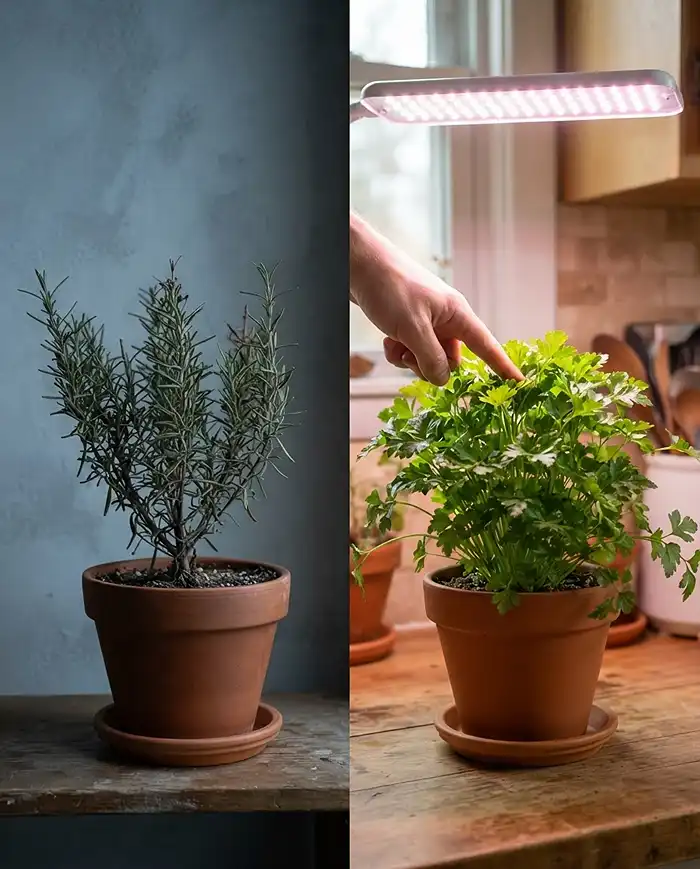
LED lights [full-spectrum grow bulbs] trick herbs into growing. My ‘Giant of Italy’ parsley sat 8 inches under lights for 14 hours a day at 68°F. With three quarter-strength feeds, it stayed deep green. The unfed pots paled by mid-January.
Pale new leaves under strong light mean hunger. Pale leaves under dim light mean you need more light, not fertilizer.
Verdict: Use a gentle liquid organic. Fish emulsion or liquid kelp at quarter strength is the best fertilizer for herbs in pots in winter. Skip synthetics.
Start with fresh mix at pH 6.5. My guide to the best soil and fertilizer for container vegetable gardens covers the base. Iowa State Extension’s indoor herb guidance also suggests half or quarter strength.
High nitrogen [the N in NPK, the leafy-growth number] forces soft, fast growth. Under weak winter light, that growth turns etiolated [pale and stretched]. It tastes flat and draws aphids.
Mistake to avoid: Using a 20-20-20 on herbs in pots in January. The fix is a low-NPK organic, plus a deep flush.
Both mix into water, so they won’t dump nutrients the way granules do.
Verdict: Feed three times at one-quarter strength between November and February. Flush between feeds. Dormant pots get none of it.
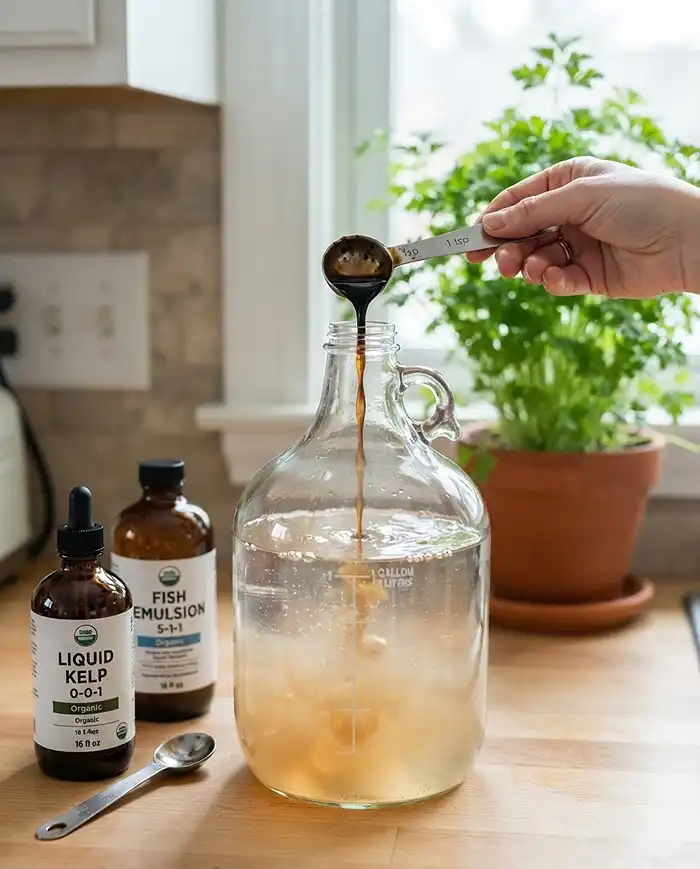
Take the label’s summer dose and divide by four. If it says 2 tablespoons per gallon, mix 1.5 teaspoons per gallon. Mix fresh each time.
Water with plain water first, then feed. Fertilizer hitting bone-dry soil burns roots fastest.
I space feeds seven weeks apart. Here’s the calendar I used for my lit kitchen pots.
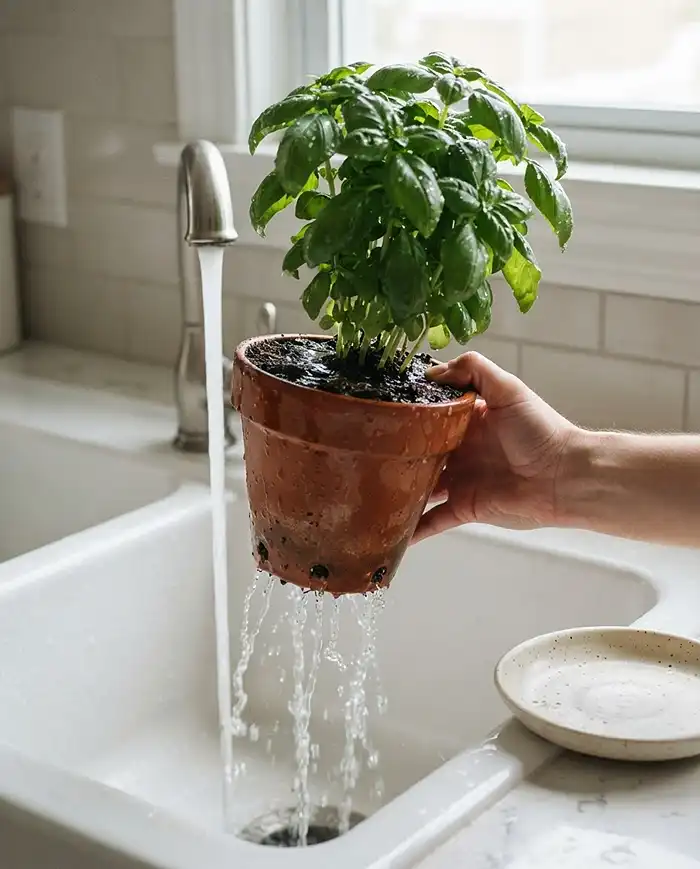
Flushing means watering until water runs out the bottom. Use about twice the pot volume. For a 1-gallon pot, run 2 gallons through in the sink.
This washes out unused salts. Let the pot drain fully. Empty the saucer within 15 minutes.
Verdict: Fertilizer only works when water and light match it. Water less, give 14 hours of light, and pinch tips. Feeding can’t fix a bad window.
Use the finger test. Push a finger in 2 inches. If it’s damp, wait. In September my kitchen pots needed water every 4 days. By January it was every 9 to 10 days. The mudroom pots went three weeks between drinks.
Pinch tips every 10 to 14 days. It keeps stems compact under weak light and sends energy to the roots. Keep pots 6 inches apart so air moves between them.
Verdict: Most winter problems come from too much feeding or too much water. Fix the pot before you feed again.
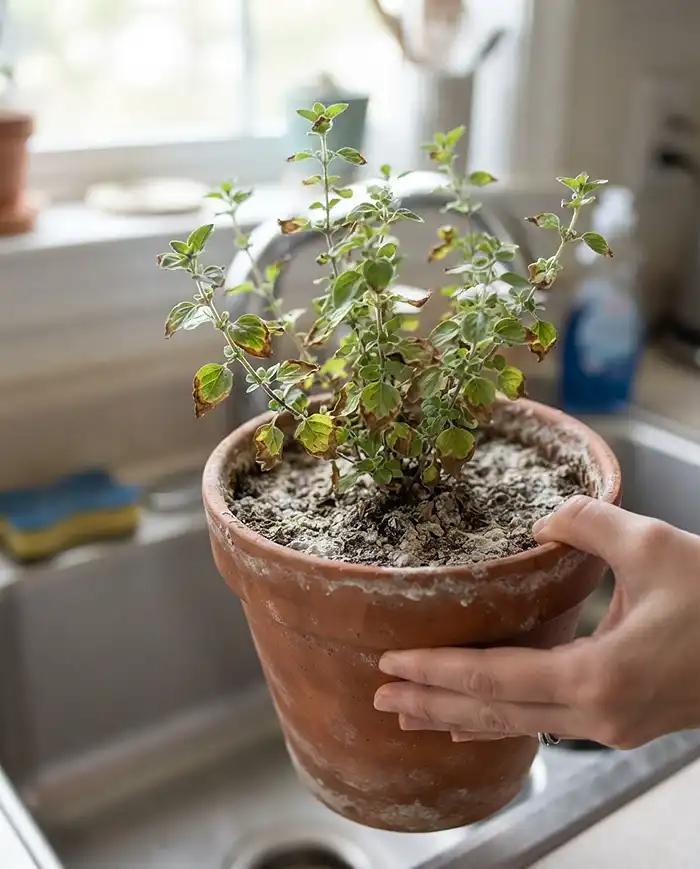
Brown, crispy edges on older leaves mean salt buildup. A white crust on the soil or rim confirms it. Flush in the sink with 2 gallons of plain water for a 1-gallon pot. Trim burned leaves and skip feeding for 8 weeks.
True nitrogen starvation is rare in winter. Root rot from overwatering is likelier. Slide the plant out and check the roots. White and firm is healthy. Brown and mushy means rot, so cut those roots and repot in fresh mix.
Suspect hunger only if new growth stays pale for 3 weeks under good light and the pot is 8 weeks past its last feed.
No. Spikes and granules release nutrients every time you water, in amounts you can’t control. In a 1-gallon pot with slow roots, that raises burn risk fast. Use a liquid at quarter strength every 6 to 8 weeks instead.
Skip them. Uncomposted grounds often grow mold on warm soil, and they can tie up nitrogen as they break down. In a 68°F kitchen, mold can show up within about two weeks.
Wait until late March or early April, when days pass 12 hours and herbs push thick, bright green growth. Make the first feed half strength, then go to full strength about 3 weeks later. In zone 8b, the last frost lands around March 10.
No. ‘Tuscan Blue’ rosemary and English thyme go dormant below about 55°F and want zero fertilizer until mid-March. My unfed rosemary grew under half an inch in four months and survived.
Look for pale new leaves that stay small for 3 weeks under at least 12 hours of light, with no feed in 8 weeks. Check roots and watering first. If both look fine, give one quarter-strength feed.
I run trials on a south-facing concrete patio in zone 8b. This test used 12 pots from November 15, 2025 to March 15, 2026. Six overwintered in an unheated mudroom (45-55°F). Six sat in the kitchen at 68°F under LED lights.
These notes are current as of the 2026 season. No new product I tried changed the schedule.
Table of Contents
- The Delicate Balance of Feeding Herbs During Winter
- Understanding Winter Dormancy vs. Active Indoor Growth
- Choosing the Right Winter Fertilizer for Potted Herbs
- Step-by-Step Guide to the Winter Feeding Schedule
- Adjusting Care to Complement the Feeding Schedule
- Common Problems & Solutions
- People Also Ask
- The Short Version
The Delicate Balance of Feeding Herbs During Winter
Verdict: Skip your summer schedule. Winter herbs grow slowly, so unused fertilizer builds up as salt and burns the roots.
Low light and cool rooms slow a plant’s metabolism [how fast it turns food and water into growth]. Roots drink less, so they take up less fertilizer. The rest sits in the pot as salts [leftover mineral residue].
I learned this the hard way in winter 2024-25. I fed ‘Kaliteri’ oregano 20-20-20 [equal parts nitrogen, phosphorus, potassium] at label strength every two weeks. By week five, three of four pots had brown leaf edges and aphids. The likely cause: salt buildup in 1-gallon pots.
Good winter herb care is mostly restraint. If you fed in fall, my fall container fertilizer schedule shows where to stop.
Understanding Winter Dormancy vs. Active Indoor Growth
Verdict: Diagnose first. Dormant herbs get zero fertilizer. Herbs under grow lights get a light feed every 6 to 8 weeks.
Most of my container herbs fell into one of three groups.
| Setup | Typical herbs | Growth | Feed? |
|---|---|---|---|
| Cool room, 45-55°F | Rosemary, thyme, sage | Stops | No. Zero until mid-March |
| Warm kitchen, LED 14 hours | Parsley, basil, chives, mint | Slow but steady | Quarter strength, every 6-8 weeks |
| Sunny window, no lights | Mixed herbs | Barely | Once in January, only if pale |
Identifying True Winter Dormancy in Outdoor/Cool Room Pots
Rosemary and thyme [Mediterranean herbs] go dormant below about 55°F. They stop growing and want nothing from you. My four ‘Tuscan Blue’ rosemary in 2-gallon pots grew under half an inch from November to February. All four survived, unfed.
The logic matches my fall fertilizer for container vegetables advice: stop feeding when growth stops.
- Do this: Leave dormant pots alone until new growth appears in mid-March.
- Skip this: Feeding a plant because it “looks tired.” Dormant plants always look tired.
Assessing Active Growth in Heated, Grow-Light Environments
LED lights [full-spectrum grow bulbs] trick herbs into growing. My ‘Giant of Italy’ parsley sat 8 inches under lights for 14 hours a day at 68°F. With three quarter-strength feeds, it stayed deep green. The unfed pots paled by mid-January.
Pale new leaves under strong light mean hunger. Pale leaves under dim light mean you need more light, not fertilizer.
Choosing the Right Winter Fertilizer for Potted Herbs
Verdict: Use a gentle liquid organic. Fish emulsion or liquid kelp at quarter strength is the best fertilizer for herbs in pots in winter. Skip synthetics.
Start with fresh mix at pH 6.5. My guide to the best soil and fertilizer for container vegetable gardens covers the base. Iowa State Extension’s indoor herb guidance also suggests half or quarter strength.
The Dangers of High-Nitrogen Synthetic Fertilizers
High nitrogen [the N in NPK, the leafy-growth number] forces soft, fast growth. Under weak winter light, that growth turns etiolated [pale and stretched]. It tastes flat and draws aphids.
Mistake to avoid: Using a 20-20-20 on herbs in pots in January. The fix is a low-NPK organic, plus a deep flush.
Gentle Organic Options: Fish Emulsion and Liquid Kelp
- Fish emulsion (about 5-1-1): Gentle nitrogen. It smells strong in a warm kitchen, so buy a deodorized formula.
- Liquid kelp (about 1-0-1): Mild, with trace minerals. My pick for kitchen shelves.
- Check your label: NPK numbers vary by brand.
Both mix into water, so they won’t dump nutrients the way granules do.
Step-by-Step Guide to the Winter Feeding Schedule
Verdict: Feed three times at one-quarter strength between November and February. Flush between feeds. Dormant pots get none of it.
The “Quarter-Strength” Dilution Rule
Take the label’s summer dose and divide by four. If it says 2 tablespoons per gallon, mix 1.5 teaspoons per gallon. Mix fresh each time.
Water with plain water first, then feed. Fertilizer hitting bone-dry soil burns roots fastest.
Fertilizing Indoor Herbs in Winter: The 6-to-8 Week Cycle
I space feeds seven weeks apart. Here’s the calendar I used for my lit kitchen pots.
| Date | Action |
|---|---|
| Nov 20 | Feed #1, quarter strength |
| Dec 15 | Flush with plain water |
| Jan 8 | Feed #2 |
| Feb 1 | Flush |
| Feb 26 | Feed #3 (last one) |
| Late March | Resume normal feeding, half strength first |
Flushing the Soil Between Feedings
Flushing means watering until water runs out the bottom. Use about twice the pot volume. For a 1-gallon pot, run 2 gallons through in the sink.
This washes out unused salts. Let the pot drain fully. Empty the saucer within 15 minutes.
Adjusting Care to Complement the Feeding Schedule
Verdict: Fertilizer only works when water and light match it. Water less, give 14 hours of light, and pinch tips. Feeding can’t fix a bad window.
Drastically Reducing Winter Watering Frequencies
Use the finger test. Push a finger in 2 inches. If it’s damp, wait. In September my kitchen pots needed water every 4 days. By January it was every 9 to 10 days. The mudroom pots went three weeks between drinks.
Pruning and Harvesting to Manage Weak Growth
Pinch tips every 10 to 14 days. It keeps stems compact under weak light and sends energy to the roots. Keep pots 6 inches apart so air moves between them.
- Do this: Pinch just above a leaf pair. Harvest no more than one-third at a time.
- Skip this: Cutting dormant rosemary or thyme back hard.
Common Problems & Solutions
Verdict: Most winter problems come from too much feeding or too much water. Fix the pot before you feed again.
Fertilizer Burn (Brown, Crispy Leaf Edges)
Brown, crispy edges on older leaves mean salt buildup. A white crust on the soil or rim confirms it. Flush in the sink with 2 gallons of plain water for a 1-gallon pot. Trim burned leaves and skip feeding for 8 weeks.
Rapid Yellowing of Lower Leaves
True nitrogen starvation is rare in winter. Root rot from overwatering is likelier. Slide the plant out and check the roots. White and firm is healthy. Brown and mushy means rot, so cut those roots and repot in fresh mix.
Suspect hunger only if new growth stays pale for 3 weeks under good light and the pot is 8 weeks past its last feed.
People Also Ask
Should I use fertilizer spikes or slow-release granules in winter?
No. Spikes and granules release nutrients every time you water, in amounts you can’t control. In a 1-gallon pot with slow roots, that raises burn risk fast. Use a liquid at quarter strength every 6 to 8 weeks instead.
Can I use coffee grounds to fertilize indoor winter herbs?
Skip them. Uncomposted grounds often grow mold on warm soil, and they can tie up nitrogen as they break down. In a 68°F kitchen, mold can show up within about two weeks.
When should I resume my normal summer feeding schedule?
Wait until late March or early April, when days pass 12 hours and herbs push thick, bright green growth. Make the first feed half strength, then go to full strength about 3 weeks later. In zone 8b, the last frost lands around March 10.
Should I fertilize rosemary and thyme in winter?
No. ‘Tuscan Blue’ rosemary and English thyme go dormant below about 55°F and want zero fertilizer until mid-March. My unfed rosemary grew under half an inch in four months and survived.
How do I know my indoor herbs actually need feeding?
Look for pale new leaves that stay small for 3 weeks under at least 12 hours of light, with no feed in 8 weeks. Check roots and watering first. If both look fine, give one quarter-strength feed.
The Short Version
- Fertilizing indoor herbs in winter means quarter strength, once every 6 to 8 weeks, and only for herbs under lights.
- Dormant rosemary and thyme get nothing until mid-March.
- Use fish emulsion or liquid kelp. Skip spikes, granules, and 20-20-20.
- Flush with twice the pot volume between feeds, and water only when the top 2 inches are dry.