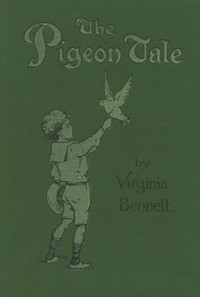
The Pigeon Tale — Reading Companion
Edition facts
The opening chapter of The Pigeon Tale establishes a farmhouse that is not merely a setting but an animate presence: the pine trees “swayed and nodded to each other as if whispering together,” the gate swings “as in anticipation of a visitor,” and the house itself “had put on its company manners.” This personification extends to the box-hedge standing “like an old soldier at attention.” The prose dwells on sensory details—lavender-scented sheets, a silk patch-work quilt, the odor of home-made bread—before the boy Laurie even arrives. The house is waiting for him, and the narrative waits with it, building expectancy through accumulated gestures of the natural world.
From Domestic Threshold to Woodland Passage
The story moves deliberately from the human realm into a fantasy one, and the transition is marked by physical thresholds. Laurie first enters the farmhouse; later, a squirrel leads him down a winding stair inside a tree. The journey continues through a long passage “smelling of earth and mould,” then up another stair into a dead tree where an owl lives. Each boundary—door, stair, corridor—is described with care, and the guide (squirrel or pigeon) always leads. The repeated phrase “led the way” reinforces that Laurie is a passive follower, and the reader follows with him. The underground passage suggests a network beneath the farm, hinted at when Laurie wonders “if the moles and mice have streets just as we do.” The structure thus depends on a series of nested spaces, each revealed by passing through a door.
Recurring Images: Lanterns, Keys, and Glow-Worms
Light sources recur as practical and symbolic objects. In the squirrel’s cellar, a guide “fastening a glow worm inside” a lantern lights the way. Later, the owl’s room contains a “revolving globe on a stand” that Laurie is made to sit on—an uncomfortable, unstable object. The contrast between the warm glow-worm lantern and the cold, spinning globe underscores the difference between the squirrel’s hospitable home and the owl’s cluttered, near-sighted chamber. Keys also appear: the door-keeper squirrel “kept jingling a great bunch of keys in his hands.” These small, tangible items anchor the fantasy in physical detail, making the impossible feel concrete.
Voice and the Limits of Laurie’s Perspective
The narrative voice shifts between an omniscient observer and Laurie’s limited point of view. Laurie’s thoughts are given directly: “Oh, dear! I do hope we don’t meet that dreadful turkey-gobbler.” He also reflects on the animals’ behavior, noting that “all the birds and animals on the farm here have such a curious way of knowing what I’m thinking.” This self-awareness creates a mild irony—the reader knows more than Laurie does, yet the story never fully explains the rules of this world. The owl’s gruff “To-who-to-who?” is presented as a question Laurie misinterprets, and the narrative does not clarify whether the animals truly understand human speech or merely seem to. This ambiguity is a deliberate structural choice, leaving the fantasy slightly opaque.
Movement Between Scenes: The Pigeon as Guide
The pigeon of the title appears as a guide, but its role is understated. It leads Laurie from the squirrel’s party to the owl’s chamber, carrying a folded paper “from a pocket underneath his wing.” The pigeon does not speak much; its function is to move the plot from one encounter to the next. The transitions between scenes are abrupt: after the squirrel’s feast, “it was time to be off,” and the group simply proceeds. There is no explanation of how the tree passages connect or why the owl is the judge. The narrative prioritizes sequence over causality, mimicking a child’s experience of one surprising event after another. The closing of each scene is marked by a door closing or a guide departing, as when the squirrel with the lantern “disappeared down the corridor.”
The Farm as a Memory Palace
The farmhouse is not only a setting but a repository of family history. The narrative explains that Laurie’s mother visited as a girl, and the house remembers her. The sheets “smelled of lavender” and the quilt was made “by some bride for her trousseau long ago.” These details anchor the fantasy in a specific, nostalgic past. The fantasy world of talking animals is thus layered over a real, remembered place. The story does not explain whether the animals are real or imagined; it simply presents both realms as equally vivid. This duality gives the tale a quiet emotional weight, as the house’s expectancy is fulfilled not by the mother’s return but by her son’s arrival.
The Pigeon Tale is a short work that balances domestic realism with woodland fantasy. Readers may notice how the narrative withholds explanation: the rules of the animal world, the purpose of the pigeon’s message, and the extent of Laurie’s imagination are left open. The story rewards attention to its physical details—the feel of a spinning globe, the smell of earth in a passage, the jingle of keys. These small, concrete observations ground the fantasy and give it a texture that lingers beyond the final page.