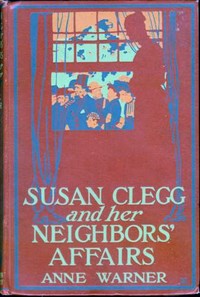
Susan Clegg and Her Neighbors' Affairs — Background and Themes
Edition facts
Susan Clegg's voice dominates from the first page: she is preparing tea, muttering about a difficult conversation ahead, and already framing her neighbor Mrs. Lathrop as a passive listener. The opening establishes a rhythm of domestic action punctuated by spoken monologue, with Susan's brisk movements—hooking a chair with her foot, scrupulously erasing evidence of her meal—mirroring her verbal precision. The November chill and the lamp shining from Mrs. Lathrop's window create a contained, intimate stage for the gossip and crises to come.
The excerpts reveal that Warner builds scenes around Susan's extended speeches, often delivered across a fence or on a porch, while Mrs. Lathrop nods or remains silent. This asymmetrical dialogue is the engine of the book: Susan's complaints, speculations, and negotiations drive the plot, and the reader must infer events from her digressive, opinionated retellings.
A Voice That Carries the Story
Susan Clegg's speech is the book's primary medium. She does not simply report events; she interprets, judges, and embellishes them with a blend of folk wisdom, misremembered scripture, and sharp observation. When she says, “It says in the Bible that if you 'n' Mohamet ain't on the mountain you 're bound to have the mountain 'n' Mohamet both on you,” the mangled proverb reveals her habit of bending received knowledge to fit her own experience. Her language is concrete and physical: she describes a wheat-fly dispute, a blacksmith's anvil, and a debt settled with currants and root beer. These details ground her complaints in tangible, small-town economics.
Warner rarely lets Susan speak without a listener. Mrs. Lathrop's silent nods and apologetic looks serve as a foil, emphasizing Susan's dominance. The reader, like Mrs. Lathrop, is positioned as an audience to a one-sided conversation, piecing together the larger story from Susan's digressions.
Money, Debt, and Neighborly Obligation
Financial anxiety runs through every excerpt. Susan frets over ten-cent weedings, ten dollars she “never touch[es],” and the cost of Lucy Dill's wedding. Her negotiations with Mr. Dill and the blacksmith over a broken leg are framed as a legal and economic transaction: a signed paper, a promise to preserve currants, and a settlement that leaves her feeling put-upon. Money is never abstract; it is tied to specific goods and services—root beer, an anvil, a hat.
The neighbors' affairs are often about who owes what to whom. Young Doctor Brown's experiments with crick polliwogs and asthma cures are treated as another kind of debt: the town is “mad over the crick,” and the doctor's claims create a new currency of hope and skepticism. Susan's own poverty is a recurring theme, but she presents it as a burden she manages with grim competence, not as a plea for sympathy.
The Unseen Events Behind the Monologue
Warner withholds direct narration of key events. The deacon's dilemma, the automobile, Gran'ma Mullins's woe, and Lucy Dill's wedding are all reported secondhand through Susan's voice. The reader never sees the wedding; instead, Susan describes the cost, the currants, and the negotiations. This technique forces the reader to become an active interpreter, weighing Susan's biases and gaps.
For example, when Susan says, “I 've had to take the ten dollars as I never touch, 'n' the ten as I never will touch,” the repetition suggests a private vow that the reader must reconstruct. The excerpts do not reveal what happened to that money, only that Susan feels trapped by her own principles. Similarly, the crick's supposed medical properties are presented as a town rumor, filtered through Susan's skepticism. The reader is left to decide how much of the story is fact and how much is Susan's embellishment.
Humor Through Repetition and Understatement
Warner's comedy relies on Susan's relentless, deadpan delivery. She describes her trials—a broken leg, a wheat-fly infestation, a lawsuit—with the same matter-of-fact tone she uses for making tea. The humor emerges from the gap between the seriousness of the events and Susan's unflappable, practical response. When she says, “I don't see why any one should be surprised over me lookin' worried,” the understatement is comic because the reader has just heard a litany of disasters.
Repetition is another tool. Susan's habit of restating her grievances, often with slight variations, creates a rhythm that mimics oral storytelling. Her closing line to Mrs. Lathrop—“if I come to starvation it would never be nothin' but a joy to me to see you starve with me”—is both a threat and a declaration of loyalty, typical of her paradoxical relationships. The humor is never cruel; it arises from Susan's unwavering self-regard and her ability to find a silver lining in even the most absurd situations.
Reading Susan Clegg and Her Neighbors' Affairs requires patience with its one-sided conversations and a willingness to read between the lines. Pay attention to what Susan does not say—the silences, the nods, the unfinished sentences—as much as to her torrent of words. The book rewards a slow, attentive reading that savors the specific details of early twentieth-century small-town life: the price of a hat, the taste of root beer, the weight of a debt. Let Susan's voice carry you, and trust that the story will emerge from her digressions.