
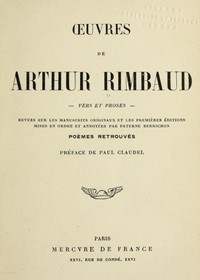
Oeuvres de Arthur Rimbaud: Vers et proses by Arthur Rimbaud
This isn't a book with a plot in the usual sense. There's no main character to follow, except maybe Rimbaud's own wild, searching mind. It's a collection of his life's work in verse and prose, arranged to show his incredible journey. You start with his early, more traditional poems, written when he was a brilliant but restless schoolboy. Then, you watch him explode.
The Story
The 'story' is the rapid, fiery evolution of a poet. In just a few years, Rimbaud tore up the rulebook. He wrote 'Le Bateau ivre' ('The Drunken Boat'), a dizzying poem from the perspective of a boat lost at sea, which became a symbol for his own rebellion. He developed his 'visionary' theory, believing a poet must become a 'seer' through a 'long, gigantic, and rational derangement of all the senses.' His prose poems in 'Illuminations' are like shattered, beautiful dreams—vivid flashes of cities, colors, and emotions. Then, in his late teens, he wrote 'Une Saison en Enfer' ('A Season in Hell'), a raw, confessional work where he looks back at his chaotic life and artistic struggles. Shortly after, he stopped writing poetry altogether and spent the rest of his short life traveling and working abroad.
Why You Should Read It
You should read Rimbaud for the sheer energy. His writing isn't meant to be perfectly understood on the first try. It's meant to be felt. He gives you permission to see the world in a weirder, more intense way. Reading him is like getting a shot of creative adrenaline. He reminds you that art can be dangerous, personal, and revolutionary. Even when his images are confusing, they stick with you—like his famous idea that vowels have colors (A is black, E is white, I is red...). It's the work of a prodigy who burned too bright to last, and that intensity is still contagious.
Final Verdict
This collection is perfect for anyone who loves language that pushes boundaries. It's for readers who enjoyed the rebellious spirit of Jack Kerouac or the surreal images of Bob Dylan's lyrics. It's also great for people curious about how modern poetry broke free from its old forms. Don't worry about 'getting' every reference. Just dive in and let the wild imagery wash over you. You'll come out the other side seeing poetry—and maybe the world—a little differently.
This historical work is free of copyright protections. You can copy, modify, and distribute it freely.
Paul Williams
3 months agoI started reading this with a critical mind, the cross-referencing of different chapters makes it a great study tool. A trustworthy resource that I'll keep in my digital library.
Kevin Ramirez
1 year agoGreat reference material for my coursework.
Margaret Davis
2 months agoIt’s rare to find such a well-structured narrative nowadays, the evidence-based approach makes it a very credible source of information. Well worth the time invested in reading it.