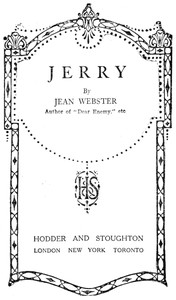
Jerry — Themes and Context
Edition facts
The novel opens in the courtyard of the Hotel du Lac, where the young American Jerymn Hilliard Jr. receives a letter from his sister announcing her arrival. The scene establishes a pattern of miscommunication and theatrical expectation: the waiter Gustavo assumes the letter is a love-letter, but Jerry corrects him with a sigh. The narrative voice is wry and observant, noting that Gustavo's eye usually held 'anxiety' when resting on Jerry, who once demanded a tennis partner 'as if the hotel kept partners laid away in drawers.' This blend of comic exaggeration and precise social detail sets the tone for a story that repeatedly contrasts American directness with European formality.
Misunderstandings Across Languages
The excerpts repeatedly highlight the gap between languages and social codes. Constance Wilder, an American girl in Italy, struggles to follow the English of Italian officers: she once laughed at what she thought was a funny story, only to learn it was 'an announcement of the death of the lieutenant’s grandmother.' To avoid further blunders, she resorts to 'inarticulate murmurs' that could be taken as either assent or denial. Her cousin Constance (the text uses the same name for two characters) acts as an unobtrusive translator, bridging 'from the officer’s English into real English.' These moments underscore a persistent theme: the difficulty of reading intent across cultural lines, a problem that also surfaces in romantic and class interactions.
Class and the Donkey-Driver
A central tension emerges between Tony, a donkey-driver, and Lieutenant di Ferara, an Italian officer. When the lieutenant kisses Constance’s hand, Tony’s expression is 'more than impertinent.' The lieutenant responds with a threat, his hand going 'half instinctively to his sword.' Constance dismisses Tony, saying, 'If a man elects to be a donkey-driver, he must swallow the insults that go with the part.' Yet Tony’s defiance—his 'laugh which was more impertinent than the stare had been'—suggests a refusal to accept his assigned place. The narrative does not resolve this clash, but it frames Tony as a figure who disrupts the social order, hinting at a romance plot that may cross class boundaries.
Scenic Tableaux and Ironic Observation
Webster composes scenes with painterly attention to color and position. When Constance stands with the lieutenant on the terrace, the description reads like a staged picture: 'Constance wore white, the lieutenant pale blue; an oleander tree beside them showed a cloud of pink blossoms.' The view from an approaching boat makes the tableau 'particularly effective.' Yet this aesthetic arrangement is undercut by the characters’ obliviousness—they are too absorbed to notice the boat until the sail falls. The narrator’s eye for ironic juxtaposition extends to Jerry’s earlier complaint about leaving the hotel: 'Not that I want to leave you, Gustavo, but—Oh thunder!' The comedy lies in the gap between romantic settings and prosaic emotions.
Readers should attend to the way Webster uses minor characters—Gustavo, the parrot, the officers—as mirrors for the protagonists’ self-deceptions. The novel’s title, Jerry, may signal a focus on the male lead, but the excerpts give equal weight to Constance’s perspective and to Tony’s silent resistance. The incomplete text leaves open how these threads resolve, but the patterns of misreading and social performance are consistent throughout the available passages.