
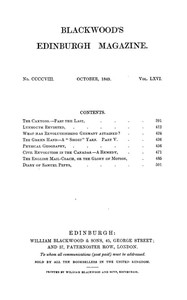
Blackwood's Edinburgh Magazine, Volume 66, No. 408, October 1849 by Various
Let's be clear from the start: this isn't a novel. Blackwood's Edinburgh Magazine, Volume 66, No. 408, October 1849 is a single monthly issue from one of the most influential periodicals of its day. Think of it as the Victorian equivalent of a high-brow monthly magazine, a podcast, and a newspaper op-ed section all rolled into one beautifully printed package.
The Story
There's no single plot. Instead, you step into a flow of content from a specific moment in history. One piece might be a gripping installment of a serialized novel (a common way to publish fiction then). The next could be a fierce essay on the political unrest in Europe, written just months after major revolutions. Then you might find a detailed account of a scientific discovery, a humorous sketch of city life, or a somber poem. It's a miscellany, a curated slice of what educated, curious Britons were reading over their breakfast tables and in their clubs during one autumn month.
Why You Should Read It
This is history without the textbook filter. The writing is direct, opinionated, and alive. You feel the authors' personalities—their wit, their prejudices, their sense of wonder. Reading an essay on a new technology, you share the writer's genuine amazement. Reading a political piece, you feel the tension of a society worried it might be coming apart. It completely shatters the stiff, formal image we often have of the Victorians. These people were arguing, joking, and trying to make sense of a rapidly changing world, much like we do today. The experience is immersive in a way few history books can match.
Final Verdict
Perfect for history buffs who want to get beyond dates and treaties, and for readers who love primary sources. It's also a treasure trove for writers looking to understand the rhythm and style of 19th-century prose. If you prefer a straightforward, linear story, this might feel scattered. But if you're the kind of person who loves digging through archives or would happily spend an afternoon in a museum reading old letters, you'll be fascinated. It's a direct conversation with the past, and it's absolutely riveting.
This historical work is free of copyright protections. Preserving history for future generations.
Linda Davis
1 year agoJust what I was looking for.
Melissa Williams
1 year agoI was skeptical at first, but the plot twists are genuinely surprising. A true masterpiece.